Everyone talks about “the grieving process.”
The stages.
Denial.
Anger.
Bargaining.
Depression.
Acceptance.
This model was introduced in 1969 by Elisabeth Kübler-Ross, and it has become something people often refer to when trying to understand grief.
If only it were that simple.
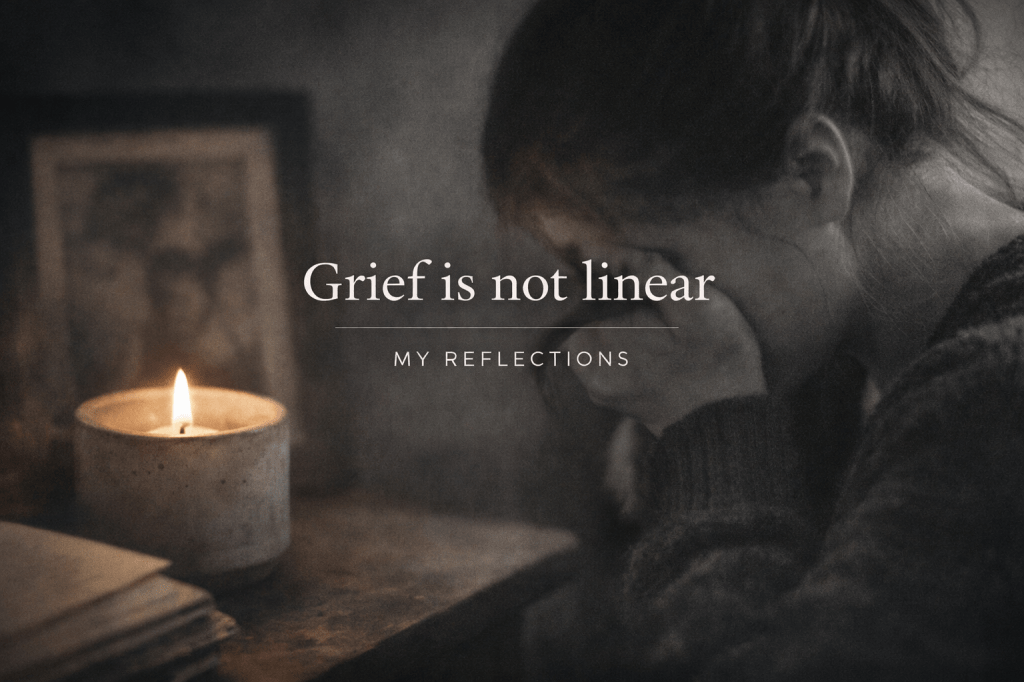
Grief is not linear.
It is not a checklist.
It is not a step-by-step process.
It is not something you move through neatly, one stage at a time.
You don’t go from denial… to anger… to acceptance… and then you’re done.
You can feel everything at once.
Or nothing at all.
You can go from feeling completely numb…
to overwhelming sadness…
to anger…
and then right back to denial.
All in one day.
Sometimes in one hour.
There is no timeline.
No one tells you how long each stage lasts.
No one tells you when it will get easier.
No one tells you when you’ll be able to breathe again without feeling like your chest is collapsing.
And honestly… I wish someone could.
I wish there was a timeline.
I wish someone could say, “By this point, you’ll feel a little better.”
But that’s not how this works.
Grief is unpredictable.
It comes in waves.
Sometimes quiet.
Sometimes so overwhelming it feels like you are drowning.
And then there are the parts no one really talks about.
The parts that don’t fit neatly into those five stages.
The guilt.
The confusion.
The questions that will never have answers.
When you lose someone you love to suicide, grief becomes something else entirely.
It becomes heavier.
More complicated.
More painful in ways that are hard to explain.
The guilt is constant.
Even when people tell you:
“It’s not your fault.”
“You couldn’t have known.”
“You didn’t make this decision.”
Your mind doesn’t listen.
Instead, it replays everything.
Every conversation.
Every argument.
Every moment.
You start asking yourself questions you will never be able to answer:
Could I have done more?
Should I have seen the signs?
Did I miss something?
Was it me?
You know, deep down, that nothing will change what has happened.
But your mind doesn’t stop trying.
Then comes the confusion.
That feeling of not understanding your own reality.
It doesn’t feel real.
You still think they are coming back.
You still want to call them.
You still expect their message to pop up on your phone.
You hear your notification tone…
and for a second… you think it’s them.
And then you remember.
That moment.
Over and over again.
Grief like this is not just sadness.
It is shock.
It is trauma.
It is trying to make sense of something that will never make sense.
Some days, the sadness is unbearable.
It feels like your heart is physically breaking.
Your chest aches.
You can’t stop crying.
You feel like you won’t make it through the day.
But somehow… you do.
And then there are the days where you feel nothing at all.
And that is just as confusing.
People say things like:
“How are you doing?”
“You’re so strong.”
“You’ll get through this.”
And I know they mean well.
But sometimes… those words don’t help.
Because I don’t want to be strong.
I don’t want to “get through this.”
I just want my husband back.
That’s the truth of it.
Grief is messy.
It is unpredictable.
It is exhausting.
It is painful in ways you cannot explain unless you have lived it.
There is no right way to do this.
There is no correct timeline.
There is no finish line.
There is only this moment.
And the next.
And the next.
And if you are going through something similar…
Please know this:
There is nothing wrong with how you are grieving.
This is not a process you have to get right.
This is something you are surviving.

Leave a comment